


 简体中文
简体中文 Español
 日本語
日本語

















 2024.12.03
1. Introduction
Industrial control systems are the core of modern manufacturing, and their stable operation is directly related to production continuity, equipment safety, and product quality. Switching Power Supplies, as the critical power supply units for industrial control systems, are responsible for providing stable and reliable DC power to devices such as Programmable Logic Controllers (PLCs), servo drives, industrial robots, Human-Machine Interfaces (HMIs), and various sensors and actuators. Compared to commercial-grade power supplies, industrial-grade Switching Power Supplies require a precise balance in design between conversion efficiency, power density, cost control, and environmental adaptability to meet the specific requirements of industrial sites.
2. Core Requirements for Switching Power Supplies in Industrial Control Environments
The special working conditions of industrial sites impose strict technical requirements on Switching Power Supplies:
Environmental Adaptability: Capable of withstanding harsh industrial environments such as temperature fluctuations, mechanical vibration, dust, and humidity.
Operational Reliability: Requires extremely low failure rates (typically MTBF exceeding 100,000 hours) to ensure continuous and stable operation of production systems.
Electromagnetic Compatibility (EMC): Possesses good anti-interference capability while controlling its own electromagnetic emissions.
Dynamic Performance: Provides sufficient voltage hold-up time to ensure control systems can complete safety procedures during grid transient interruptions.
System Integration: Supports standardized installation, rapid maintenance, and meets intelligent monitoring needs.
3. Core Technical Features
3.1 Environmental Adaptability Design
Wide Operating Temperature Range: Standard industrial-grade power supplies typically operate from -25°C to +70°C, with extended ranges available from -40°C to +85°C.
Mechanical Structure Reliability: Passes IEC 60068-2-6 standard vibration tests, utilizes PCB reinforcements, dedicated fixing structures for core components, and metal enclosures for EMI shielding and mechanical protection.
Protection Rating: Complies with IEC 60529 protection standards; commonly IP20 for inside control cabinets, with higher ratings like IP65/IP67 required for harsh environments.
3.2 Electrical Reliability Design
Protection Mechanisms:
Basic Protection: Over-voltage, over-current, short-circuit protection.
Advanced Protection: Over-temperature protection using auto-recovery Hiccup mode.
Fault Warning: Reports fault information via status indicators or communication interfaces.
Hold-up Time Characteristic: According to IEC 61131-2 standard, hold-up time requirement is ≥20ms at rated load.
Redundant Architecture: Supports N+1 redundant parallel configuration, employs active current sharing technology, and includes output isolation circuits.
3.3 Electromagnetic Compatibility Design
Electromagnetic Immunity: Meets industrial-grade requirements of the IEC 61000-4 series standards, with surge immunity reaching Level 4 (Differential Mode 2kV, Common Mode 4kV).
Emission Control: Conforms to EN 55032 Class A limits; controlled through optimized topology, EMI filters, and shielding techniques.
3.4 Intelligence and Maintenance Design
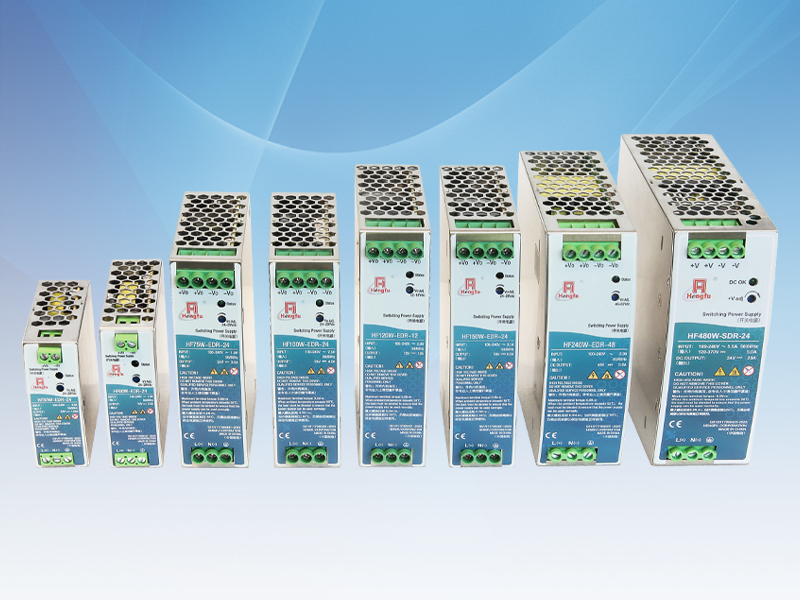
Installation and Maintenance: Complies with DIN EN 60715 standard for rail mounting; features front wiring and front maintenance design.
Monitoring Functions: Supports industrial communication protocols such as PMBus and CANopen for real-time monitoring of operating parameters, fault recording, and early warning.
4. Typical Application Analysis
| Application Scenario | Core Needs | Key Technical Requirements |
|---|---|---|
| PLC Control Systems | High Reliability, Stable Output | Low Output Ripple, Comprehensive Protection, Sufficient Hold-up Time |
| Servo Drive Systems | Dynamic Response, Anti-interference | Excellent Load Characteristics, High Power Density, Strong EMC Performance |
| Industrial Robots | Compact Size, Vibration Resistance | High Power Density, Reinforced Structure, Wide Temperature Operation |
| Process Control Systems | Continuous Operation, High Availability | N+1 Redundancy, Intelligent Monitoring, Remote Diagnosis |
| Outdoor Control Equipment | Environmental Adaptability | High Protection Rating, Wide Temperature Operation, Corrosion Resistance |
5. Conclusion
In the field of industrial control, the technological development of Switching Power Supplies continuously evolves around the goal of high reliability. Their value assessment has expanded from solely energy conversion efficiency to a comprehensive performance indicator system including environmental adaptability, operational reliability, system maintainability, and intelligent connectivity capabilities. Modern industrial-grade Switching Power Supplies provide reliable power assurance for industrial automation systems through innovative topology design, advanced material application, and intelligent functions. With the advancement of Industry 4.0 and smart manufacturing, intelligent power supplies featuring condition monitoring and predictive maintenance capabilities will become the development trend.





 沪公网安备31011702890774号


