


 简体中文
简体中文 Español
 日本語
日本語

















 2025.10.15
1. Introduction
In modern mechanical equipment, a stable and reliable power supply is the fundamental prerequisite for ensuring its precision, efficiency, and continuous operation capability. As a core component that converts input electrical energy into stable DC electrical energy required by loads, the performance of switching power supplies directly affects the performance indicators, reliability level, and life-cycle cost of the entire equipment. Unlike ordinary commercial power supplies, industrial-grade switching power supplies used in mechanical equipment have their design concepts and technical characteristics centered on coping with harsh industrial environments and meeting high-standard system integration requirements. This paper aims to systematically elaborate on the core technical characteristics of such power supplies and their application considerations in typical mechanical equipment.
2. Core Technical Characteristics
To adapt to the working environment of mechanical equipment, industrial-grade switching power supplies undergo specialized design and enhancement in terms of environmental adaptability, electrical reliability, and mechanical structure.
2.1 Excellent Environmental Adaptability
Wide Temperature Range and Robust Thermal Management
Operating Temperature Range: Standard models typically support a wide temperature range of -25℃ to +70℃, while wide-temperature models can extend this range to -40℃ to +85℃. This ensures that equipment can start and operate normally in high summer temperatures and low winter temperatures in workshops without air conditioning.
Thermal Design Strategy: Low thermal resistance metal enclosures are used, and PCB copper foil layouts are optimized to enhance heat conduction. For medium-to-high power or high-density installation scenarios, special thermally conductive potting compounds are generally used for overall potting. This not only establishes an efficient heat dissipation path but also simultaneously improves moisture resistance, corrosion resistance, and vibration resistance.
High-Level Protection and Mechanical Robustness
Protection Level: Strictly complies with the IEC 60529 standard. Power supplies installed in control cabinets commonly use the IP20 rating to prevent accidental contact with live components by personnel. For equipment directly exposed to processing environments (such as machining centers with cutting fluid splashing and food packaging machines requiring high-pressure cleaning), IP65/IP67 ratings must be selected to achieve dustproofing and protection against water jets/immersion.
Vibration and Shock Resistance: The internal design is reinforced to withstand the inherent vibration and shock of mechanical equipment, including:
PCB reinforcing ribs and thick copper foil design.
Adhesive fixing or mechanical buckles for high-mass components such as electrolytic capacitors and transformers.
Compliance verification through standard tests such as IEC 60068-2-6 (vibration) and IEC 60068-2-27 (shock).
Excellent Electromagnetic Compatibility (EMC)
Electromagnetic Immunity: Must meet the severe levels for industrial environments specified in the IEC/EN 61000-4-2/3/4/5/6 series standards (e.g., ESD contact discharge 8kV, EFT 4kV, Surge 4kV) to resist strong interference generated by servo drives, frequency converters, and relay switching.
Electromagnetic Emission Control: Through optimized circuit topologies, EMI filters, shielded enclosures, and rigorous PCB layout and routing, conducted and radiated emissions are strictly limited within the limits of EN 55032 Class A (industrial environments) or the more stringent Class B (residential areas), avoiding interference with sensitive numerical control and detection units in the system.
2.2 Extremely High Electrical Reliability and System Availability
Comprehensive Protection Mechanisms
In addition to basic overcurrent, overvoltage, and short-circuit protection, industrial-grade power supplies generally integrate overtemperature protection. The advanced "hiccup mode" protection mechanism can enter a shutdown-self-recovery cycle when a fault occurs and automatically resume normal operation after the fault is eliminated, greatly improving the system's self-healing capability and unattended operation time.
Critical "Hold-Up Time"
In accordance with standards such as IEC 61131-2, to ensure that core controllers such as PLCs and servos can save current processing data and execute safe shutdown procedures when the power grid is momentarily cut off, the power supply must have sufficient hold-up time. Typically, under rated input voltage and full-load conditions, the hold-up time should be no less than 20ms. This directly depends on the capacity and quality of the primary-side high-voltage bus capacitor.
Redundant and Scalable Architecture
In critical applications such as continuous production lines, N+1 redundant parallel solutions are commonly adopted. Through built-in or external current-sharing circuits, multiple power supply modules are ensured to share the load evenly. When a single module fails, the system can complete on-line replacement without affecting operation, achieving "zero downtime" maintenance.
2.3 User-Friendly Operation and Maintenance Design
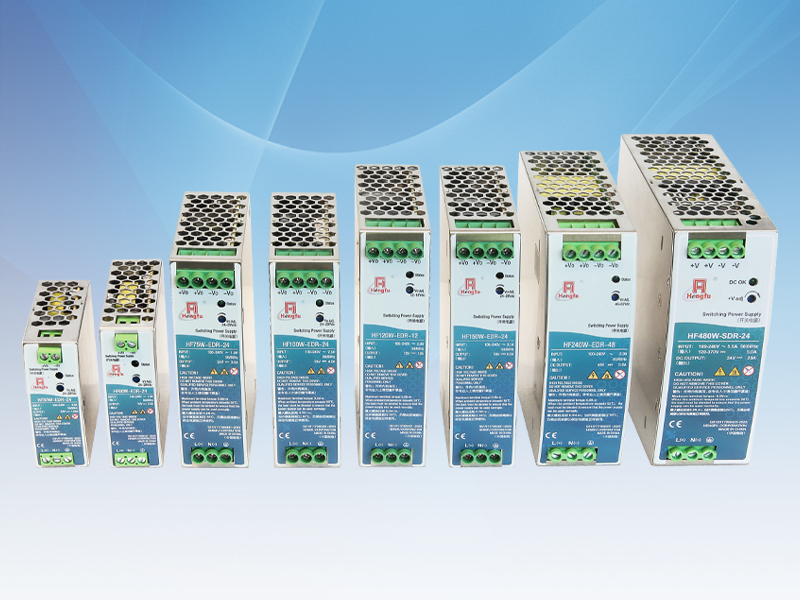
Standardized Installation: Generally compatible with 35mm symmetrical rail mounting in accordance with the DIN EN 60715 standard, which greatly simplifies the installation and disassembly process.
Convenient Electrical Connection: Provides large-capacity, anti-loosening screw terminals or tool-free spring-loaded terminals to support reliable connection of thick-diameter cables.
Status Indication and Communication: Equipped with clear LED status indicators (Power, PGOOD). High-end models integrate digital interfaces such as PMBus, CANopen, or IO-Link, enabling real-time remote monitoring of voltage, current, internal temperature, load rate, and fault records, providing a data foundation for predictive maintenance.
3. Application Analysis in Typical Mechanical Equipment
CNC Machine Tools/Machining Centers
Core Power Supply Requirements: Extremely high reliability, electromagnetic interference resistance, and sufficient hold-up time.
Recommended Power Supply Characteristics: Wide-temperature design, high EMC performance, hold-up time ≥20ms, and low ripple noise.
Industrial Robots/Robotic Arms
Core Power Supply Requirements: Compact size, vibration resistance, and high dynamic response.
Recommended Power Supply Characteristics: High power density, enhanced anti-vibration design, and excellent dynamic load response.
Packaging and Filling Machinery
Core Power Supply Requirements: Hygienic requirements, corrosion resistance, and easy maintenance.
Recommended Power Supply Characteristics: High protection level (IP67), stainless steel enclosure or compliant coating, and front-wiring design.
Plastic Molding Machines
Core Power Supply Requirements: High-temperature environment adaptability and high reliability.
Recommended Power Supply Characteristics: Wide-temperature model (up to 85℃), redundant configuration capability, and robust protection functions.
Logistics Sorting Systems
Core Power Supply Requirements: Long-term continuous operation and modular maintenance.
Recommended Power Supply Characteristics: High MTBF (Mean Time Between Failures), N+1 redundancy, and hot-swappable design.
4. Conclusion
In the field of modern mechanical equipment where automation and intelligence are deeply integrated, the role of switching power supplies has evolved from a simple "energy converter" to a "power and information hub" that ensures the stable, efficient, and intelligent operation of the entire system. Its value evaluation standard is a multi-dimensional comprehensive system covering environmental adaptability, electrical performance, reliability indicators, maintainability, and data interaction capabilities. Selecting an industrial-grade switching power supply that truly meets standards is not only a technical decision to ensure the stable operation of a single piece of equipment but also a strategic investment in building a smart manufacturing system with high availability and low total cost of ownership. In the future, as the intelligence level of equipment continues to improve, digital power supplies integrating condition monitoring and intelligent management functions will become mainstream, further enhancing the core competitiveness of mechanical equipment.





 沪公网安备31011702890774号


